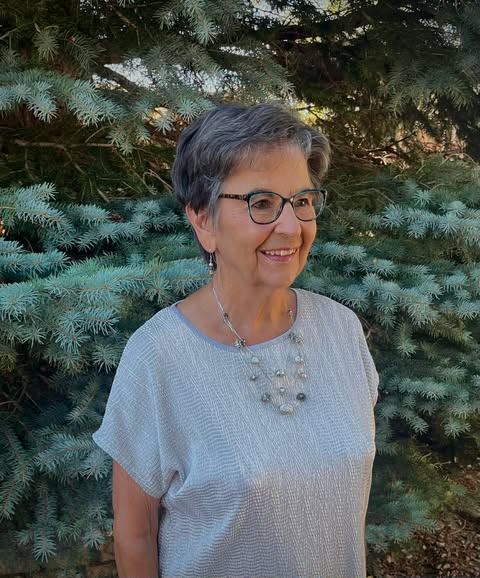
A Glimpse into Grandma’s Heart

By the time I knew Grandma Schultz (my great grandmother) she was so hard of hearing that no one could have a discussion with her. My best recollection of her is that of a slight, hunched woman sitting quietly in a rocking chair in a corner of her daughter’s (my maternal grandmother) dining room. Her thinning gray hair and many wrinkles supported the fact that she had seen nearly a century of these Thanksgiving dinners that we were about to partake of. Two of the men, one on each side of Grandma, helped her to the table. Once the prayer had been offered, the food was passed. It was easier to point and tip the bowl showing Grandma what was in it than it was to shout out SWEET POTATOES, DRESSING,  SCALLOPED CORN. She would nod or shake her head. I wasn’t sure what a stroke was, but I did know that after Grandma came home from the hospital she needed a lot of help.

As a young child I could only imagine Grandma as she was at the time – never as a child or young adult.  It did not occur to me to even think about what she might have liked to do as a child my age, because in my immature mind the idea that she had been one  seemed implausible.

Grandma Schultz was ninety-five years old when she passed away; I was eight. It may have been at her funeral as the minister read the obituary that I began to see her as more than the old woman I had been familiar with. She had grown up as a little girl somewhere I had never heard of – he called it Germany. I sat in the pew and wondered what little girls in Germany did. Did they play “jacks” and jump rope? Had Grandma played with dolls or had she made mud pies and climbed trees? Had she had a pony? Did she have a best friend in Germany to tell secrets to? As I filed past her casket and stole glances at her motionless body, I knew I had lost the opportunity to have my questions answered by the one that knew those answers best.

Time marched on and I listened through the years to stories told by Grandma Martha and my own mother. It may not have been from the horse’s mouth, but many facts were revealed to me about Grandma Schultz. She had crossed the ocean to come to America when she was fifteen. As an adult she loved flowers and shared a flower garden with her daughter who lived next door. She became a seamstress and sewed for the folks in the tiny village where she and my Grandpa Julius lived. She enjoyed fine needle work and spent many evenings crocheting under the kerosene lamp in the kitchen. And one of my favorite things I learned – she always went to the storm cellar, clutching her well worn Bible.

Although I have learned a lot of facts, it’s the feelings that go along with the facts that still remain absent. What kind of fears did Grandma have when she stepped off that boat onto a new land, surrounded by those that spoke a language she couldn’t understand? Was she at peace when she made the decision to withhold  surgery for her brain-injured child after being told it could paralyze or even kill him? Or was she consumed with guilt as she was forced to watch him suffer with agonizing headaches throughout his life? These are the answers that can only come from Grandma herself.

As the decades passed, I became a mother and then a grandmother, too. Things that were once inconsequential to me in my younger years have taken a cherished position now.   I often find myself looking at the quilt made by Grandma Schultz. I display it on a rack near the fireplace. With her skilled seamstress hands, she has placed perfectly even rows of stitches between and around each of the 75 colorful butterflies. As I look at the variety of fabric used for the different butterflies I wonder what Grandma might have been asked to make with each piece. I envision women’s blouses, dresses, and aprons from the flowered prints and possibly men’s shirts and ties from the plaids and stripes.

There is one piece of fabric I don’t have to guess at any longer, as it has been identified.  Although Mom often can’t remember what she’s had for dinner an hour ago, long term memory is frequently intact. I showed her a picture of the quilt on my recent visit to see her at the assisted living facility. She immediately pointed to the pink butterfly and said, “Grandma made me a jumper out of that one.”  Little did Mom realize she was giving me a glimpse into Grandma’s heart – a heart that gave the kind of gift that is seldom forgotten.

Until next month – keep on readin’ and I’ll keep on writin’.

Grandma Schultz  Grandma Schultz's quilt


Garden Maintenance

Gardening has become a spring anticipatory event for me. I start watching the long range weather forecasts the beginning of May. Will it be safe to put my garden in by Mother’s Day or will that be a foolish move I’ll regret? Should I be patient and wait for Memorial Day like many of the locals do?  Do I trust the weatherman that gives me the green light to plant early this year, or do I play it safe  – avoiding the “I told you so,” that the locals are sure to say if a freeze wipes out my tomatoes.

I think about my options for about two minutes. With a small shovel in one hand and a favorite trowel in the other, I head for the garden spot somewhere close to Mother’s Day. As I remember, I only had to hold my breath two nights of those first two weeks. The morning I turned my calendar up to June, I felt a bit smug to have carrots, radishes, peas, and lettuce already above ground. My tomatoes were looking good, too. Was it too preposterous to think we might be eating BLT’s and Mom’s macaroni salad (with tomatoes and cucumbers) before being threatened with the first fall frost?

I find it fun to try some new things in my garden each year. This year I had extra space available to do more of that. I realized through the growing season of 2017 that next year I should cut back on my zucchinis, yellow squash, beets, radishes, and cabbage. My first clue was catching the neighbor’s blinds closing when approaching with my little red wagon.

I gave it a lot of thought what to put into my extra space. I thought about broccoli and Brussels sprouts for a nanosecond. Corn was an option, but not a good one. We have coon that like to hang out on the banks of Spearfish Creek; fifty steps from our house. These masked little guys would no doubt love some corn in their backyard – fence or no fence.  I’ve never been too excited about green beans or jalapeno peppers.

After scrutinizing all sides of the turntable seed display at the local Bomgaars, I settled  for arugula, watermelon,  cantaloupe, and four celery plants.  I had not planted any of these things in any of my previous gardens. I was a little embarrassed to have to ask the clerk how to pronounce “arugula.” When she shrugged her shoulders, I was more than okay with that.

I considered growing my watermelon in  boxes to make them square like they do in Japan for ease of stacking. Now that I’ve turned my calendar to July and I’m seeing the progress of my three struggling watermelon plants, I’m more convinced than ever that attempting to produce square melons would have been fruitless. It may still be.

I work in my garden almost every day –  hoeing, fertilizing, pulling weeds, harvesting lettuce, arugula, and peas, powdering the cucumbers, cantaloupe, and watermelon. It reminds me of the sign I saw  this morning in Belle Fourche, SD – Another great day – ruined by responsibility. Anyone who has even had a small garden, knows it’s a lot of work to maintain.

I consider all the hours in a week I put into my garden to make it look nice and to insure we get a bountiful harvest. I compare that with the time I put into growing friendships and maintaining those I have. If I’m truthful, my friendship garden is often wilting from infrequent rains and I am guilty of not sharing my sunshine with those that could use some encouragement.

For the next few weeks  I will try to maintain both my gardens just a little bit better, tending to friendships as well as vegetables.

Until next month – ‘keep on readin’ and I’ll keep on writin’.

A Sneak Preview

I promised a scene from the book, Bound by Three Strands, as this month’s blog.  I am in the process of formatting the book and am hopeful for a release date this month. This book will be available in both paperback and kindle edition, as was the first book of the series. This book is a sequel to Bound by Secrecy, published in 2016. I took one of my favorite characters from Book 1 – Doc Vince – and he is now the protagonist in this sequel. The characters from Book 1 continue to show up frequently in this book as well. For those that have read Bound by Secrecy, you will remember Laurel, Tom, Joshua, Beau, Valerie, and Ethan Clayburn, to name a few. You will also be introduced to Seth Redrick, a new and somewhat mysterious character, who’s first meeting with Doc occurs over a puncture wound and a very odiferous sock, causing Doc to inhale deeply once he escapes the non-ventilated exam room. I have chosen to give you a glimpse of the very first scene of Bound by Three Strands. Watch Amazon for the day of release. A signed copy will be available through me by emailing delilalumbardy@gmail.com. A donation to St. Jude’s Hospital will be made from the proceeds of the signed copies.

Chapter One…On His Own

There wasn’t much that could dampen Doc Vince’s spirits, but the three other patrons in the post office lobby noted Doc’s immediate silence as he pulled the envelope from his post office box. They also noticed his pinched eyebrows creating worry lines above the bridge of his nose. This was not the usual jovial Doc that greeted everyone with a slap on the back and a warm smile.

Removing his keys from the box, Doc turned and left the post office with not so much as a nod to the other patrons. He nearly stumbled off the curb as he studied the writing on the envelope. There was no doubt this was the same handwriting as the other two notes; the letters of every word widely spaced and quite legible. This was the third one he had received in less than a month. A cold shiver ran down his spine as he ripped the envelope open. This time the note was written with a narrow felt tip marker rather than an ink pen; maybe suggesting he better pay attention.

Dr. Vince Peters:

I was not kidding when I wrote the other two notes. Marrying Ginny Phillips is a bad idea. You best heed my warnings.

The note was signed just as the other two had been. No name; no initials…just a scribble that looked something like a recumbent “S”. Doc reached in and pulled the other two notes from the inner breast pocket of his sport jacket.  He compared this newest one with the other two.  Except for the felt tip pen that the writer had used this time, the notes looked much the same. Each one was written on lined yellow paper with the same distinctive penmanship.

In all his years of living in the small town of Hooper, Nebraska, he had not received any type of threatening notes such as this. Doc couldn’t imagine who would send such a thing. He was respected by nearly everyone in the community, or so he thought. Of course, there were always those that chose to doctor in Westfield because of desires for the latest technology and the plushest of office buildings, but that was no reason for this. He waved the notes above his head as if making a point. Likewise, he couldn’t think of a single person in the entire county that didn’t like Ginny. She had won them over by way of her home cooked meals. Available seats at the Red Rooster Café through the noon hour were as scarce as those in Memorial Stadium on any given Husker game day.

The idea of marriage had never come up between the two. Having never been married, Doc assumed he was way too engrained in his own schedules and ideas to make a marriage work now. And Ginny seemed quite content with her present situation as well. That’s another reason these notes seemed all the more mysterious. The idea of marriage was pure speculation on the sender’s part.

He had not told Ginny about the notes. He hadn’t told anyone about them. Maybe it was time to confide in his friend considering she was mentioned in the notes. She might have some idea who could be sending them and why.

(That’s all for now, folks. Formatting calls me…but, keep on readin’ and I’ll keep on writin’.)


The Philistine Camp

When I travel back to see my family in Nebraska there are a couple of different routes I can take. I can make it in a little over five hours if I head east down Interstate 90, exit at Murdo, SD, and head south; passing through the Rosebud Indian Reservation. I have taken this route many times because it is the quickest, but it’s not the one I prefer. There is one town I pass through, on this route, that if I didn’t need my sight to drive, I would gladly close my eyes and pretend it didn’t exist. Except for a newer gas station on the west end of town and a decent school on the east end of town, most of the buildings are shoddy and uncared for. Many lack paint and some windows are not windows at all, but plywood barriers cut to fit. This isn’t what bothers me the most, though. It’s the hunched shoulders, the downcast eyes, and the purposeless walk of the individuals I see as I drive through.

I much prefer to take the longer route through western South Dakota and Nebraska. On this route I notice that folks commonly wave, even to strangers. When I stop for a break in Chadron, NE the folks I meet on the street make direct eye contact and often offer a “hello.” When traveling Highway 20, this time of year, I enjoy the endless hills of growing grasses, the deep greens of the meadows along the streams and rivers, and the budding of deciduous trees close to the roadway.  Most of all though, it’s the newborn calves, romping and playing on the other side of the fences, or maybe lying in a warm spot of dandelions that makes me smile. Some of the calves will be kicking up their heels in the bright sunshine; the attentive mothers always close by and watching. Some will be pushing aggressively at their mothers’ udders with a ring of foamy milk encircling their mouths. Maybe I will even see a calf – so new – that it’s struggling to stand on its sea legs and reach for its first drink.

Just as there are different roads to take me home, there are different roads to experience in life. When I have the time, I am content to take the longer one home because it’s the more scenic and pleasant, but most often we favor the shortest routes. We tell ourselves that if we can save time, that’s what we should do. That is why McDonalds alone sells an average of 75 hamburgers every second. Yes, every second!

We may live in the “fast food” age, but the idea of getting somewhere via the shortest route isn’t anything new. The Israelites, thousands of years ago, couldn’t understand why God didn’t guide them by way of the most direct route from Egypt to the Promised Land. We know now that He was detouring them  away from the hostile Philistines. If they had come upon these fierce people, they would have been filled with fear and likely would have hurried back to where they had come from; as dreadful as it was.

Many times, the road to reach our goals seem time consuming and filled with potholes.  We would like to order them up “fast food” style and have them met immediately. We have even been known to manipulate circumstances so our goals could be reached now instead of later.  But, often, it would do us good to take a lesson from the calf lying in the dandelions – to sit quietly and prayerfully, waiting on God’s perfect direction.

If the road to meet your goal seems never ending, don’t get discouraged. It just might be that you are being detoured around a Philistine camp.

Until next month, keep on readin’ and I’ll keep on writin’.


resting in the dandelions, cropped


The Last Puzzle Piece

Since the last time we visited, my husband and I have completed a 1000 piece jigsaw puzzle. It is a picture of a great horned owl sitting on a limb of a snow covered pine tree. There were multiple browns, greens, and white pieces – and nothing else. It took us weeks to complete it, and there were many evenings we threatened to throw it back in the box and take it to the Salvation Army. But, we kept after it – after all, what else did we have to do on cold March evenings? Once completed, my oldest son asked if we were going to decoupage it and hang it. My husband said he was going to take it out and shoot it with a shotgun. However, in the end, he was the one that preserved it and will be the one that makes a frame for it. It will fit in with the décor of our log home and remind us that patience does pay off.

Jigsaw puzzles have been around since the 1700’s when John Spilsbury of London fashioned the first one out of wood. They weren’t known as jigsaw puzzles then, but as dissections. It wasn’t until 1880 that they began to be called jigsaw puzzles, but this was a misnomer as they were cut with a fretsaw – a saw not all that much like a jigsaw.

Jigsaw puzzles became very popular during the Great Depression. They provided a cheap, long-lasting, and recyclable form of entertainment. Even today,  I would consider jigsaw puzzles as being one of our least expensive forms of leisure activities. But, don’t be fooled by those you see on the shelves at Wal-Mart. In 2005 the most expensive puzzle, to date, was sold for $27,000 at a charitable auction for The Golden Retriever Foundation. The puzzle, created by  Rachel Page Elliot, predicted a female Golden Retriever with her five puppies playing in the grass. What a honor that must have been for this 92 year-young woman who hadn’t taken up puzzle making until she was in her seventies.

Besides the sense of accomplishment that’s felt when completing a puzzle, there are possibly other benefits. The Alzheimer Society of Canada proclaims that jigsaw puzzles can help keep the brain active and may reduce the risk of developing Alzheimers.

When I looked at our owl puzzle with the last piece still absent, it came to mind that this is what our lives are like without the most important piece – God. Our life is an unfinished picture when we try to fill it with “things”, but leave God out. Solomon reminds us in Ecclesiastes 3:11, that God has planted eternity in the human heart. We will never be completely satisfied with our earthly pleasures and pursuits if we leave the “most important piece – “the piece of God”- in the box.  He has built in us a restless yearning for Him, and no matter how many things we fill our life with, if we turn our backs on God, a void in us goes unfilled and peace escapes us.

Isn’t it wonderful that God discriminates against no one? Anyone can pick up that last piece and put it where it belongs. Because He wants nothing more than for us to have a relationship with Him, you can be assured it will fit perfectly.

Until next month, keep on readin’ and I’ll keep on writin’.

One piece missing  completed owl puzzle