

Rosie the Riveter Relates to Labor Day

Before Labor Day became a federal holiday in 1894, many states were already celebrating the holiday.  In 1887  Oregon became the first state to pass the holiday as law followed soon thereafter by Colorado, Massachusetts, New Jersey, and New York.  By 1894 twenty three more states would be celebrating the social and economic achievements of American workers. President Grover Cleveland passed the bill to make it a national holiday in hopes of appeasing the nation’s workers before the election  that would give him a second term. Plenty of American Railway Union workers had reason to be upset with the president following a deadly railroad strike when workers for George Pullman’s sleeping car company became outraged that Mr. Pullman cut their wages but left their rent at the usual amount. The 150,000 members of the union refused to work on trains carrying Pullman cars. The strike disrupted train travel across the nation and prompted President Cleveland to send in troops to end the strike. Many of the workers were wounded and killed. TIME magazine called it “one of the bloodiest strikes in U.S. history.” President Cleveland’s efforts to honor the worker with a holiday did not secure him the election.

As years passed, there have been many celebrated labor giants, but the most well known of labor icons has  been “Rosie the Riveter.” As the World War II posters proclaimed; she rolled up her sleeves, flexed her arm muscles and said, “We Can Do It!” This government campaign brought millions of women out of the home and into the workforce.

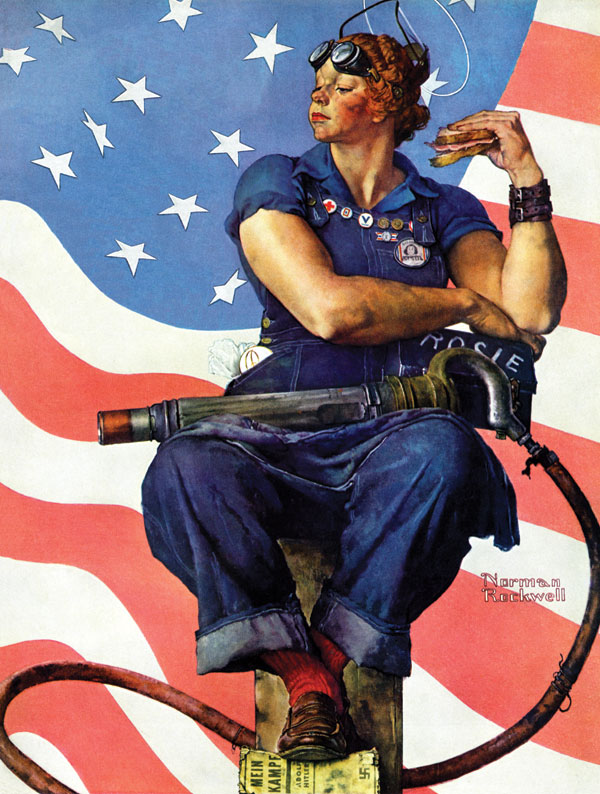
The familiar Rosie poster of the woman with the red and white polka dot bandana and blue  coveralls against a bright yellow background is not the original Rosie. The original painted Rosie – popular during the war  and created by Norman Rockwell – is found on the cover of the Saturday Evening Post of the 1943 Memorial Day issue. This image depicts a much more muscular woman wearing overalls, goggles and pins of honor on her lapel. A riveting tool lays across her lap and “Rosie” is painted on her lunchbox. She is stepping on a copy of Adolph Hitler’s book “Mein Kampf.” The Rosie most familiar to folks sixty and younger, was created by artist J. Howard Miller when he was commissioned by Westinghouse to make a series of posters to promote the war effort. It was never the intention of Miller or Westinghouse to make that image into “Rosie.” Before any of the art work of “Rosie” came into existence, she made her first appearance in song. The song, “Rosie the Riverter” by Redd Evans and John Jacob Loeb left us to picture in our individual minds our own Rosie’s.

Whether you see Rosie as the woman in the song or the one on the Saturday Evening Post or the one on the Westinghouse posters, there’s no doubt she did her part in uniting women as a major part of the work force during WWII. By 1945 nearly one out of four married women worked outside the home. The aviation industry saw the greatest increase in female workers. Women represented 65% of the industry’s total workforce, compared to just 1 % in the pre-war days. It’s no wonder that Rosie the Riverter is still considered the most successful government advertising campaign in history.

Rosie the Riverter lyrics:

While other girls attend their fav’rite                                     RosieTheRiveter_Rosie, NR
cocktail bar
Sipping Martinis, munching caviar
There’s a girl who’s really putting 
them to shame
Rosie is her name

All the day long whether rain or shine
She’s a part of the assembly line
She’s making history, 
working for victory
Rosie the Riveter
Keeps a sharp lookout for sabotage
Sitting up there on the fuselagedolhistory-rosie-lg
That little frail can do more than a 
male will do
Rosie the Riveter

Rosie’s got a boyfriend, Charlie
Charlie, he’s a Marine
Rosie is protecting Charlie
Working overtime on the 
riveting machine
When they gave her a production “E”
She was as proud as a girl could be
There’s something true about
Red, white, and blue about
Rosie the Riveter

Everyone stops to admire the scene
Rosie at work on the B-Nineteen
She’s never twittery, nervous or jittery
Rosie the Riveter
What if she’s smeared full of
oil and grease
Doing her bit for the old Lendlease
She keeps the gang around
They love to hang around
Rosie the Riveter

Rosie buys a lot of war bonds
That girl really has sense
Wishes she could purchase 
more bonds
Putting all her cash into national
defense
Senator Jones who is “in the know”
Shouted these words on the radio
Berlin will hear about
Moscow will cheer about
Rosie the Riveter!

Until next month – keep on readin’ and I’ll keep on writin’.
_____________________


Three Stories to Warm your Heart

What is it you hear every day when you turn on the news? It’s definitely not about people helping people. Wouldn’t it be enlivening to turn on the news this evening and hear only great stories about just that – people helping and caring about other people? There are so many tragic events to report, that we are forced to get our “uplifting stories” from somewhere else other than the 5:00 news. In this writing I am going to tell you three such stories that will warm your heart and make your faith in mankind swell as if it were a hot air balloon being readied for flight.

First story: An anthropologist had been doing research in a foreign village. As he waited for a ride to pick him up to take him to the airport for his return home, he decided to create a game for the children to play that were nearby. He placed a basket of fruit and candy beneath a tree and then instructed the children that the first one to the basket could have the goodies.

“Get ready, get set, RUN!” he called.

He was expecting them to all take off as fast as they could, but to his surprise, they did not. Instead, they joined hands and ran together to the tree.

“Why did you choose to run as a group, rather than each of you running for the prize?” he asked.

A small girl spoke up and said, “How could one of us be happy when all of the others are sad?”

From the mouth of babes.


The second story is about two men that occupied the same hospital room. They were both quite ill, but they became well acquainted and shared stories of their families, their military service, their favorite vacation spots, and whatever else came to mind. The fellow by the window was placed in an upright position each day for an hour to help his lungs drain the fluid that had accumulated in them. The other fellow had to lie on his back continually. It wasn’t long before this man complained of the boredom he felt in his situation. For that hour each day that the fellow by the window was sitting up, he began to describe the wonders outside his window – it overlooked a beautiful lake where the swans and ducks swam. Children raced their toy boats in a small bay and lovers walked hand in hand around the lake. Colorful flowers stretched around the edge of the lake and the cities majestic skyscrapers could be seen in the distance. The man lying flat on his back began to look forward to this hour each day when his friend would describe what he saw. He would close his eyes and imagine the picturesque scenes as his roommate described them.

Days went by and the nurse came in one morning with basins of water to bathe her patients, only to find that the fellow by the window had died peacefully in his sleep. The other man mourned the death of his new friend and his exquisite stories he told each afternoon. Once the body of his friend had been removed, he asked the nurse if he could now occupy the space by the window and she immediately obliged him – shuffling the beds about. He was now strong enough to raise up and look outside for himself, but when he did so, the window faced a solid brick wall.

“Why would he tell me he saw such wonderful things, out this window?” he asked the nurse.

“Your roommate was blind and did not know there was a brick wall outside the window.  His purpose was to encourage you.”


And the third story is recorded in the book “Unbroken” by Laura Hillenbrand – a WWII story of survival. Seven hundred emaciated and feeble POW’s occupied the Rokuroshi Japanese prison camp. Many of these men had been prisoners of war for years. Conditions were horrendous with little food and many beatings. If  they had been there any time at all, these men were made up of merely bones with skin to cover them. So great was the oppression that all these men really had were each other.

The soldiers in the camp were purposely kept from learning of the wars progression. One day all 700 of them were invited to bathe in the Hokura River which they found very odd. They weren’t about to argue about it as they dropped their clothes and waded in. Once they were all in this vulnerable spot – they heard it – the growl of an aircraft engine – huge, low, and coming straight at them. There was no mistake it was a tornado bomber. It didn’t take much of an imagination to know they had been placed as an easy and vulnerable target. But then…wait…with the bomber right over them they could see a broad white star in a blue circle! It was an American plane. The plane’s red code light was blinking rapidly. A radioman in the water read the signals and cried out, “The war is over!”

The plane turned loops above the men, and the pilot waved to them. Something flitted out of the cockpit and landed near one of the soldiers. Picking it up, he found a chocolate candy bar  with a bite already taken out of it. It would have been easy for this soldier to claim the prize and gulp down the savoring sweetness, but he didn’t. Instead he sliced the candy bar into seven hundred slivers. Each one of the prisoners licked a finger, dabbed it on his bit of chocolate, and put it in his mouth.


Ready to hop in and take that hot air balloon ride? Until next month, “keep on readin’ and I’ll keep on writin’.

 

Tristan da Cunha

TristandC-posWould you like to live in a self supporting Christian community – one that has a thriving economy, non-existent unemployment, and where serious crime is unknown? You might say, “Yes, but there is no place.” Ah…but that is not so. There is such a place. It is called Tristan da Cunha Island.

Now, there are some things you should know about Tristan (for short) before you pack your bags and rent a U-Haul truck. The first thing is – don’t bother with the truck. The only accessible route is by boat. Pack plenty of Dramamine as it is a seven day journey of 1500 miles from the nearest port at Cape Town, South Africa. “Oh,” but you say, “I’ll fly then.” No, that won’t work – there is no airstrip on the island. Another thing you should know is that no outsiders are allowed to buy land or settle on the island. Don’t fret though – visitors are welcomed and many of the women supplement their families income by selling homemade souvenirs to the tourists.

The 266 residents that  live on the 8 mile wide island have descended from 15 ancestors, 8 of which were male and 7 female. The males were European and the females were of mixed race and African. These 266 people make up 80 families. An inhabitant of the island will have one of only seven surnames.

By the map you can see that Tristan da Cunha (in the red square) lies in the Atlantic Ocean between Africa and South America and is a British Territory.  If the island residents tire of shopping in Cape Town, they can head west 2090 miles and patronize one of the South American cities. In reality, most of what the residents need are brought in by fishing vessels a few times a year.

There is only one road on the island and it is little more than a winding dirt path. It is flanked with bungalow style cottages, potato patches, and friendly roaming cows. Every family on the island farms. The adults also have other jobs – usually a government job involving the fishing industry.

Although very remote, Tristan is blessed with modern amenities of modern plumbing and electricity. Once I read that,  I thought about planning a trip, but then I found out there are no motels. Camping might be a option for some folks, but not for me. It rains 17-26 days of the month – not suitable for a fair weather camper that enjoys eating eggs in the morning sunlight.

Medical treatment can be an issue. There is a hospital on the island that is serviced by a resident doctor and five nurses. It has labor and delivery capabilities as well as an emergency room. But serious conditions must be taken to Cape Town or the UK.

Life for the Tristan da Cunha inhabitants is an exercise in patience and planning. There is a grocery store, but orders must be placed months in advance so the supplies can be loaded onto scheduled fishing vessels and brought to the island. Many times these vessels are delayed because of weather conditions.

The island’s motto is “Our faith is our strength.” I have no doubt these folks possess an adequate amount of both. It would be inspiring, interesting, and intriguing to meet these folks, but I’d prefer to do it in Spearfish, SD.

Until next month, “Keep on readin’ and I’ll keep on writin.’


The Sleepover Project

Creativity flows out of some people as easily as lava flows from a volcano. I am not one of those people. I suppose there are those that would argue with me because I am a writer. But, other than a few creative words on occasion, my creative juices sit below sea level. I admire those that can sew up an outfit without a pattern – how do they do that? Equally impressive are the ones that can mix and match spices that I’ve never heard of, all without a recipe, and walla – out comes a dish to die for. And there’s the person that can look at a room and transform it into something beautiful, all in a days work.

I am in awe of folks that God slapped with that extra measure of  “Creative DNA.” That is why I found the story of David Dillard intriguing. David does not use his creativity only for those activities he enjoys doing in his leisure time; he brought his creative abilities to the workplace.

David Dillard is the president of D2 Architecture in Dallas, Texas. His firm is known for the senior housing campuses they design. Mr. Dillard wanted his young architects not only to build quality buildings, but to really understand the folks they were building these villages for. It was his goal that his employees would come to know what this senior population needed from a building firm.

This is when Mr. Dillard launched The Sleepover Project. His young crew puts on pajamas and they spend 24 hours in a senior living center and live as if they are 80 or 90 years old. To simulate hearing loss, they wear earplugs. They swap glasses with another crew member to get a sense of the lack of visual acuity. They even tape fingers together on each hand to get the feel of the loss of mobility as when having arthritis.

Living with those who will live with what you have built has been an eye opener for Dave Dillard’s employees. Some of the things they found were that window sills were too high for residents and they could not see out. That resulted in D2 Architecture increasing the size of the windows they install by 10-20%. They also found that the elderly didn’t function well with direct lighting because it hurts their eyes. Dave’s company installs indirect lighting by using ceiling fans and light fixtures that shield the light source. The residents told them they didn’t want ramps or steps and D2 Architecture listened –  none of those bad boys! One crew member stayed in a facility where a hard of hearing resident kept his TV on so loud it disturbed the resident across the hall. The solution was quite simple and the cost the same – stagger the doorways so they aren’t directly across from each other.

How did Dave Dillard get this creative notion? “I want to build for people as opposed to building fancy beautiful buildings.” The best way he could do that was to send his employees into live with those that would be living daily with his product. Each crew member is required to keep a journal of their stay and then each bring it back to the table for discussion.

I am hopeful by reading the creativity stories of others, my lava will begin to flow. By this time next month, I just might have that bedroom painted.

Until next month, keep on readin’ and I’ll keep on writin’.


History of Mother’s Day

FYI – Before starting my blog, I would like to inform all that read it, that during the summer months I will be blogging only once a month. Many folks – both the readers and the writer – are busy enjoying the outdoors during our short summers. I will blog on the first weekend of the month.


An old Jewish proverb states that God made mothers because he couldn’t be everywhere. I don’t agree with all of this as I believe that God is omnipresent, but I also believe that mothers are very special beings which is what I think the proverb is alluding to.

Anna Marie Jarvis also thought mothers were special – special enough that there should be a day to remember them and all the good they do. She is the one credited as being the founder of the Mother’s Day holiday in the United States. Her idea came through her mother who she admired deeply for many things – one of which was tending to the wounded during the Civil War. When Anna was twelve years old she remembers hearing her mother praying and expressing that she hoped someday there would be a day given to celebrate mothers.

Anna’s mother died in 1905, but Anna never forgot her mother’s prayer. In 1907 she began to host campaigns for dedicating a day in remembrance of mothers.  In 1910 Anna’s home state of West Virginia became the first state to observe Mother’s Day. It was meant to be a day spent in church. Following the service children were assisted in writing endearing letters to their mothers. Anna also began the tradition of wearing carnations on that day – her mother’s favorite flower. Red ones were worn to show honor to the living moms, white ones were worn to honor those deceased.

By 1914, President Wilson declared Mother’s Day a national holiday. It was to be celebrated yearly, on the second Sunday of May.

Within a few short years, flower venders and card companies were capitalizing on the holiday. The commercialization of the holiday so outraged Anna that she is quoted as saying, “A printed card means nothing except that you are too lazy to write to the woman who has done more for you than anyone in the world. And candy! You take a box to Mother and then eat most of it yourself. A pretty sentiment.”

By 1924 Anna began aggressively trying to abolish the holiday she had fondly founded. Six years later she was arrested for disturbing the peace at a Mother’s Day Carnation sale. She spent the rest of her life and her family inheritance fighting the holiday.

Anna never married, and in 1948 she died, leaving no children to remember her.

Today, Mother’s Day is celebrated in 46 countries, although not all on the same day. I can understand Anna’s thought process about the commercialization, but you will not find me turning down a card, a flower, or a gift on Mother’s Day. I know so many special mothers and  each of them deserves a special moment on this Sunday.

Here’s to all the mothers who every day do what John Wesley proposed: Do all the good you can, by all the means you can, in all the ways you can, in all the places you can, at all the times you can, to all the people you can, as long as ever you can.

Until next month – if you keep on readin’, I’ll keep on writin’.